
Parallel planning in SAC

Januar 2025

Parallel planning in SAC – Who will win, the first or the last one publishing data?

As we do not have any locking in place when you do planning in SAC the question is which changes will win if two users do the planning in parallel. As always, the answer is not simple, sometimes the first saving will win, sometimes the last one.

This blog will explain the background of how SAC is handling unpublished data, how to trace them and what checks are done during save to answer our question, who will win.

Background – Private and Public Versions

When you open a SAC model in input mode all data is copied into a private version. Changes are stored in the private version until you publish the data.

All this is well described in the following learning journey:

https://learning.sap.com/learning-journeys/leveraging-sap-analytics-cloud-functionality-for-enterprise-planning/managing-versions_fe088b2d-c658-4911-a854-6cb55427eefe

A lot of questions concerning this topic are already answered in the following blogs:

FAQ: Version Management with SAP Analytics Cloud (Part I – Basics)

FAQ: Version Management with SAP Analytics Cloud (Part II – Versions in Action)

How does SAP store changes and how can I trace them?
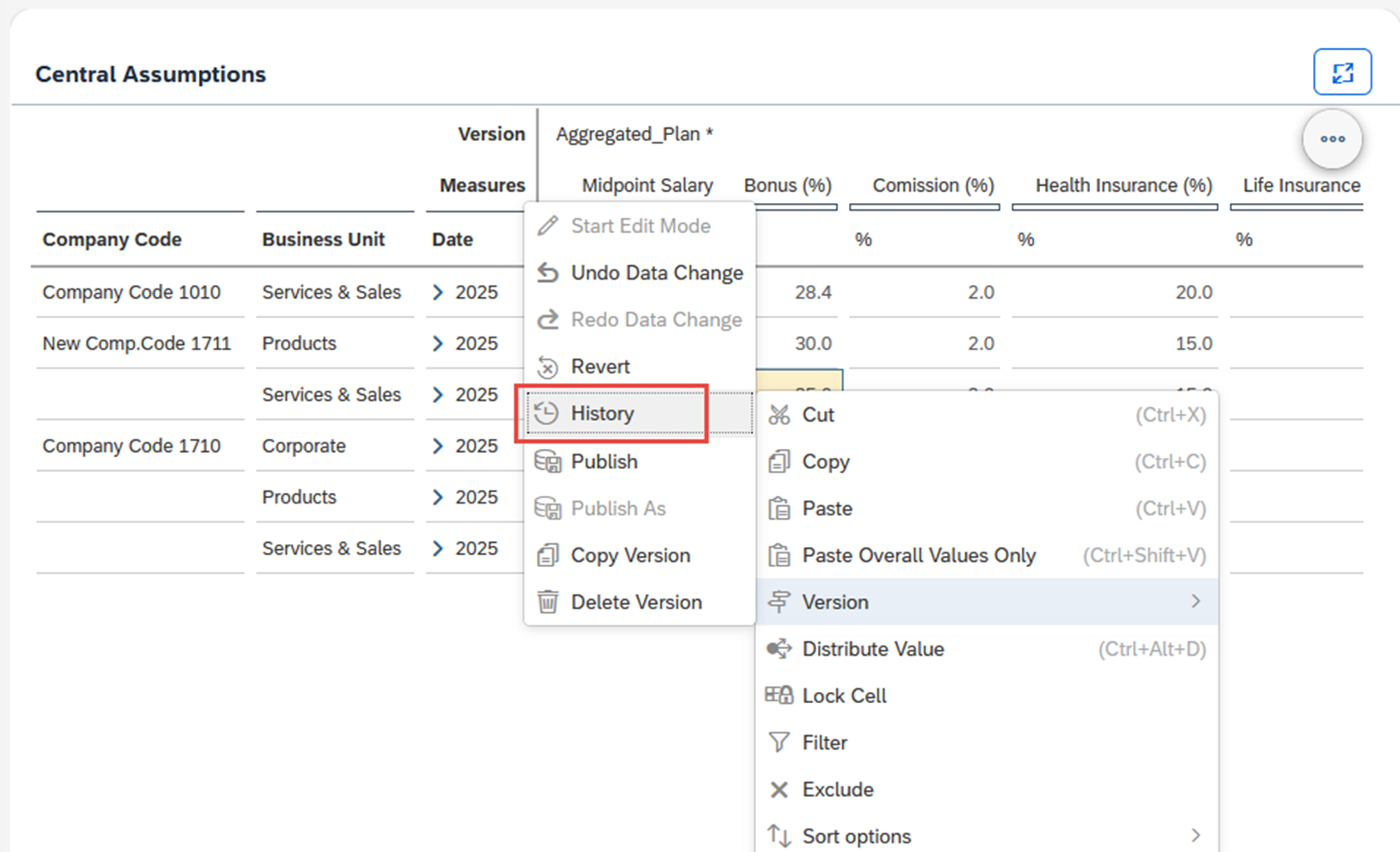
During plan data entry SAP is highlighting all changed cells. But if you have made a lot of changes, you will only see the cells highlighted of your last change.

To highlight older changes you first have to show the history information:

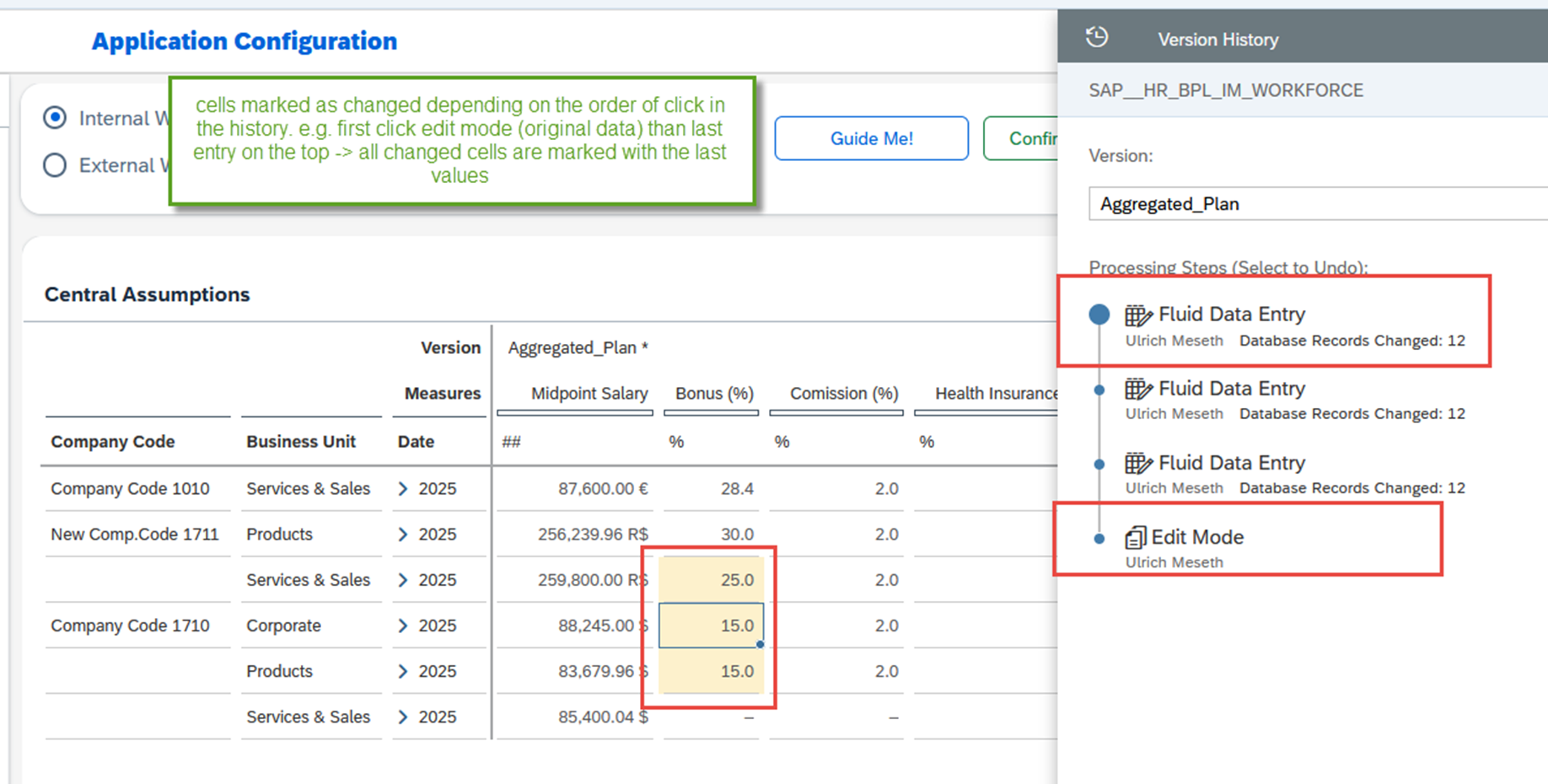
Now you will see for each entry cycle a “Fluid Data Entry” step. Depending on which step you click, the system will highlight the cells you have changed. Here you have the option to revert a single entry step as well.
Now let us have a look at how SAP stores the data. Data can be seen in the Data Foundation part of the data modeler. There you have a toggle button to switch on unsaved data. Default is the status off showing data in the public version only. If you toggle to see unsaved data, you will see a line for each fluid data entry step containing the delta value created. Thus the total of all values for a certain selection is the value you will see in the report.
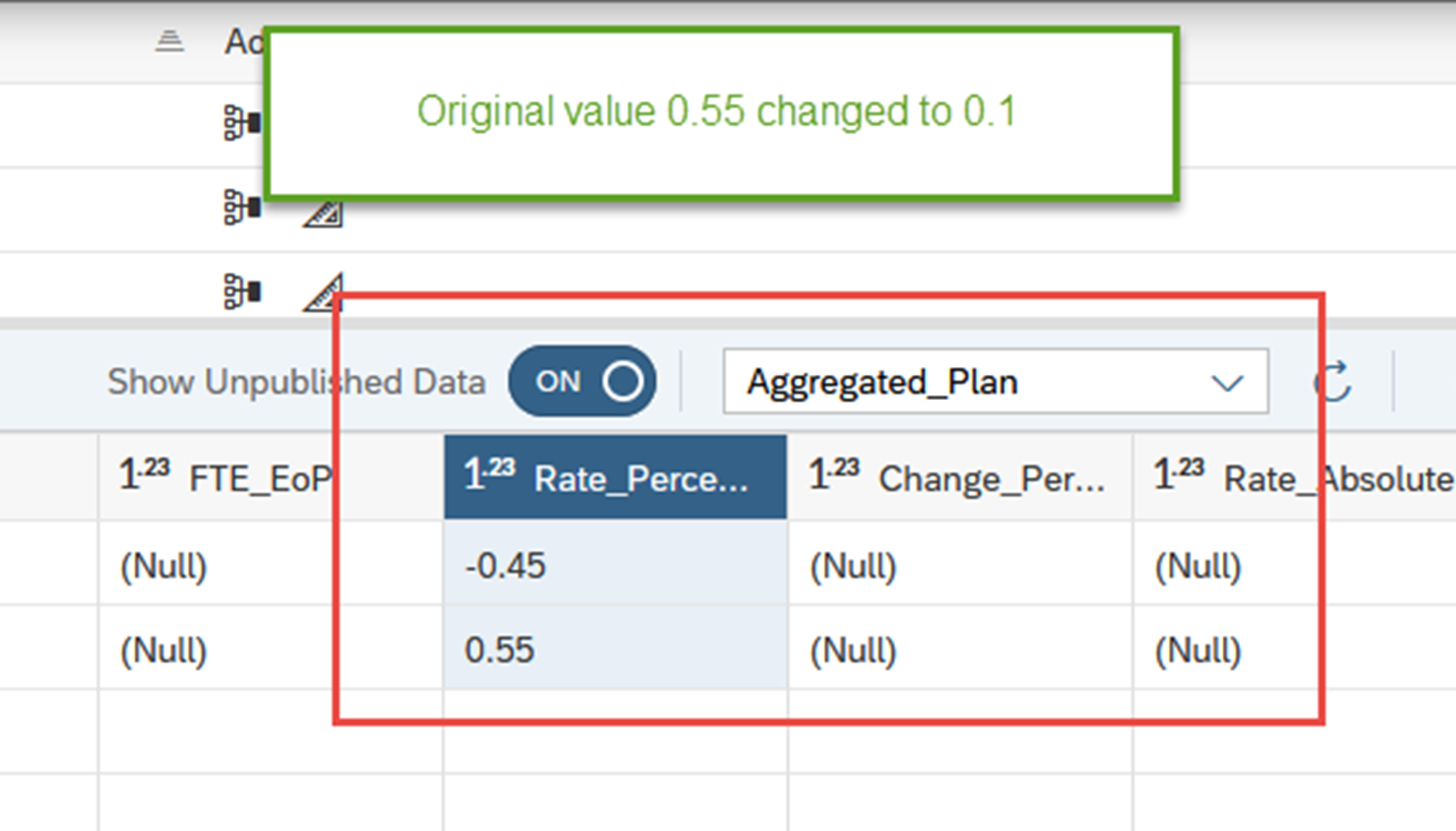
You will see unpublished data and version history only for your own user. No chance to see unpublished values of any other user.

Data checks during save

What is SAC now doing when data is saved?

SAP will compare the original value in your version history with the current public version. If values are unchanged data will be published. If values are not identical you have to decide whether to publish only your non-conflicting changes or to overwrite the other user changes:
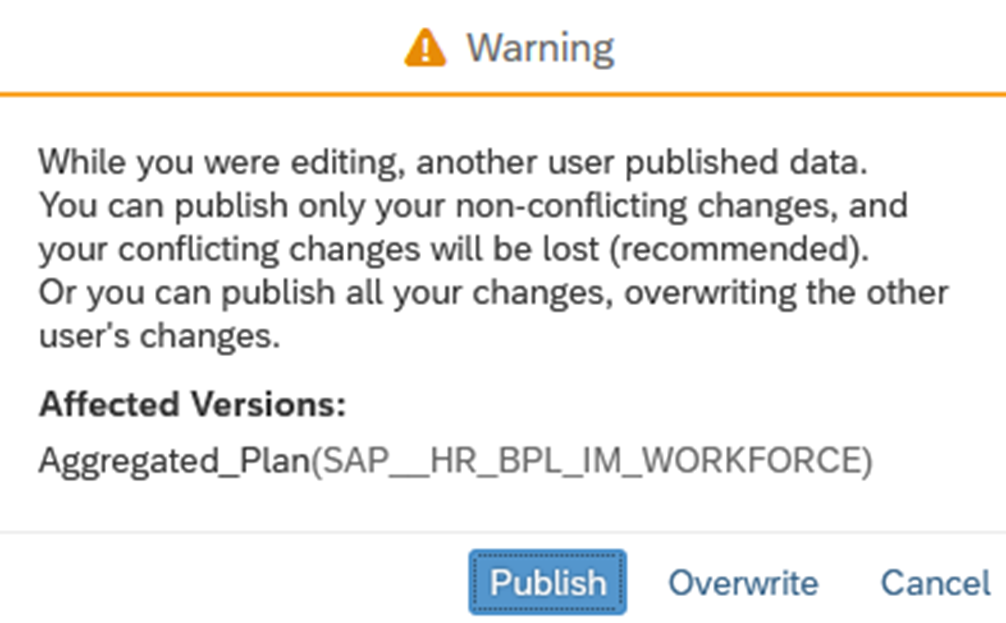
There is no way to know which are the conflicting changes (or at least we have not found a simple way to find out but we have compared all values you have changed with the current public version on a second screen).

If you would have started your planning after the other user has published the data, no warning occurs and the other user changes are overwritten. Of course, this is not parallel planning, but it may be only a second difference, if you open before or after your colleague has pressed the save button. Especially if you work with a splash down you may not realize a small change on a lower level.


Private version and planning area

In the beginning of SAC a private version did contain always the complete data. Users reported that when they opened the private version next day, no nightly updates of actual data were visible in their private version.

But with the introduction of the planning area data volume in private version is now reduced. Besides performance improvements you will see updates outside the planning area even if you work for a longer time with a private version.

Further details of how the planning area is set up and works can be found in this blog post:

Dynamic Planning Area extension for SAP Analytics Cloud

Conclusion

Changes in your private version can be nicely traced.

To avoid conflicts with other user changes and see always current status of all data, it is important to make sure that the planning area is used and do not to wait too long (e.g. over several days) before you publish your data!

Data Products Setup

I’ll start with Data Products setup. If you’re new to the concept, this recent video is a great starting point, but here’s a short summary. A data product is a well-described, easily discoverable, and consumable collection of data sets.

Creating a Data Product in Datasphere

Note that in this article I create Data Products in the Data Sharing Cockpit in Datasphere. This functionality is expected to move into the Data Product Studio, but that had not taken place at the time writing.

Before creating a Data Product in Datasphere, I need to set up a Data Provider profile, collecting descriptive metadata like contact and address details, industry, regional coverage, and importantly define Data Product Visibility. Enabling Formations allows me to share the Data Product with systems across your BDC Formation – Databricks, in this case.

With the Data Provider set up, I can go ahead and create a Data Product. As with the Data Provider, I’ll need to add metadata about the product and define its artifacts – the datasets it contains. Only datasets from a space of SAP HANA Data Lake Files type can be selected. Since this Data Product is visible across the Formation, it is available free of charge.

For this demo, the artifact is a local table containing ten years of Ice Cream sales data. Since this is a File type space, importing a CSV file directly to create a local table isn’t an option (see documentation).

I used a Replication Flow to perform an initial load from a BW aDSO table into a local table.

Once Data Product is created and listed, it becomes available in the Catalog & Marketplace, from where it can be shared with Databricks by selecting the appropriate connection details.

Jump into Databricks

To use the shared object In Databricks, I need to mount it to the Catalog – either by creating a new Catalog or using an existing one.

Databricks appends a version number to the end of the schema – ‘:v1’ – to maintain versioning in case of any future changes to the Data Product.

Once the share is mounted, the schema is created automatically, and the Sales actual data table becomes available within it. From there, I can access the shared table directly in a Notebook.

Creating a Data Product in Databricks

To create a Data Product in Databricks, I first need to create a Share – which I can either do via the Delta Sharing settings in the Catalog:

Or directly out of the table which is going to become a part of the Share:

Since a single Share can contain multiple tables, I have the option to either add the table to an existing Share, or create a new one:

To publish the Share as a Data Product, I run a Python script where I define the target table for the forecast and describe the Share in CSN notation, setting the Primary Keys. Primary Keys are required for installing Data Products in Datasphere.

Jump back into Datasphere

Once the Databricks Data Product is available in Datasphere, I install it into a Space configured as a HANA Database space – since my intention is to build a view on top of the table and use it for planning in SAC.

There are two installation options: as a Remote table for live data access, or as a Replication Flow, in which case the data is physically copied into the object store in Datasphere.

Since I want live access, I install it as a Remote Table:

and build a Graphical view of type Fact on top:

Forecast calculation

With my Data Products set up and Sales actual data are available in Databricks, I create a Notebook to calculate the Sales Forecast.

The approach combines Sales and Weather data to train a Linear Regression model. I import the Weather data *https://zenodo.org/records/4770937 from an external server directly into Databricks, select the relevant features from the weather dataset, and combine them with the Sales actual data:

* Klein Tank, A.M.G. and Coauthors, 2002. Daily dataset of 20th-century surface
air temperature and precipitation series for the European Climate Assessment.
Int. J. of Climatol., 22, 1441-1453.
Data and metadata available at http://www.ecad.eu

Using the “sklearn” library, I build and train a Linear regression model:

Once trained, the model predicts the Sales forecast for Rome in June 2026 based on the weather forecast, and I save the results to my Catalog table:

Seamless planning data model

Seamless planning concept is built around physically storing planning data and public dimensions directly in Datasphere, keeping them alongside the actual data.

Since the QRC4 2025 SAC release, it has also been possible to use live versions and bring reference data into planning models without replication.

In this scenario, I build a seamless planning model on top of the Graphical view I created over the Remote table. This lets me use the forecast generated in Databricks as a reference for the final SAC Forecast version.


The model setup follows these steps:

Create a new model:

Start with data:

Select Datasphere as the data storage:

From there, I define the model structure and can review the data in the preview.

For a deeper dive into Seamless Planning, I recommend this biX blog.

Process Flow automation

Multi-action triggers Datasphere task chain

The final step is automating the entire forecast generation by using SAC Multi-actions and a Task-Chain in Datasphere – so that my user can trigger the calculation with a single button click from an SAC Story.

The model setup follows these steps:

Create a new model:

Triggering Task Chains from Multi-actions is a recent release. This blog post walks through how to set it up.

For details on how to trigger a Databricks Notebook from Datasphere, I recommend referring to this blog.

With everything in place, I create a Story, add my Seamless planning Model, and attach the Multi-action:

Running the Multi-action triggers the Task Chain, which in turn triggers the Databricks Notebook.

I can monitor the execution details in Datasphere:

and in Databricks:

Once the calculation completes, the updated forecast appears in the Story:

The end-to-end calculation took 2 minutes 45 seconds in total. The Task Chain in Datasphere is triggered almost instantly by the Multi-action, the Databricks Notebook execution itself took 1 minute 29 seconds, with the remaining time spent on Serverless Cluster startup.   


From here, I can copy the calculated forecast into a new private version:

adjust the numbers as needed, and publish it as a new public version to Datasphere:

Conclusion

With SAP Business Data Cloud, it is possible to build a forecasting workflow that feels seamless to the end user — even though it spans multiple systems under the hood.

Companies using BW as the main Data Warehouse and Databricks for ML calculations or Data Science tasks can benefit from using the platform, as the data no longer needs to be physically copied out of BW.

What this scenario demonstrates is that once wrapped as a Data Product, BW sales data can be shared with Databricks via the Delta Share protocol. Databricks, in turn, can then create its own Data Products on top of the calculation results and share them back with Datasphere as a Remote Table.

A Seamless Planning model in SAC sits on top of that Remote Table, giving planners live access to the generated forecast. A single Multi-action in an SAC Story ties it all together, triggering a Datasphere Task Chain that kicks off the Databricks Notebook — completing the full cycle in under three minutes.

As SAP Business Data Cloud continues to mature, scenarios like this one are becoming achievable – leaving the complexity in the architecture and not in the workflow.

Contact

Ilya Kirzner
Consultant
biX Consulting
Privacy overview

This website uses cookies so that we can provide you with the best possible user experience. Cookie information is stored in your browser and performs functions such as recognizing you when you return to our website and helps our team to understand which sections of the website are most interesting and useful to you.